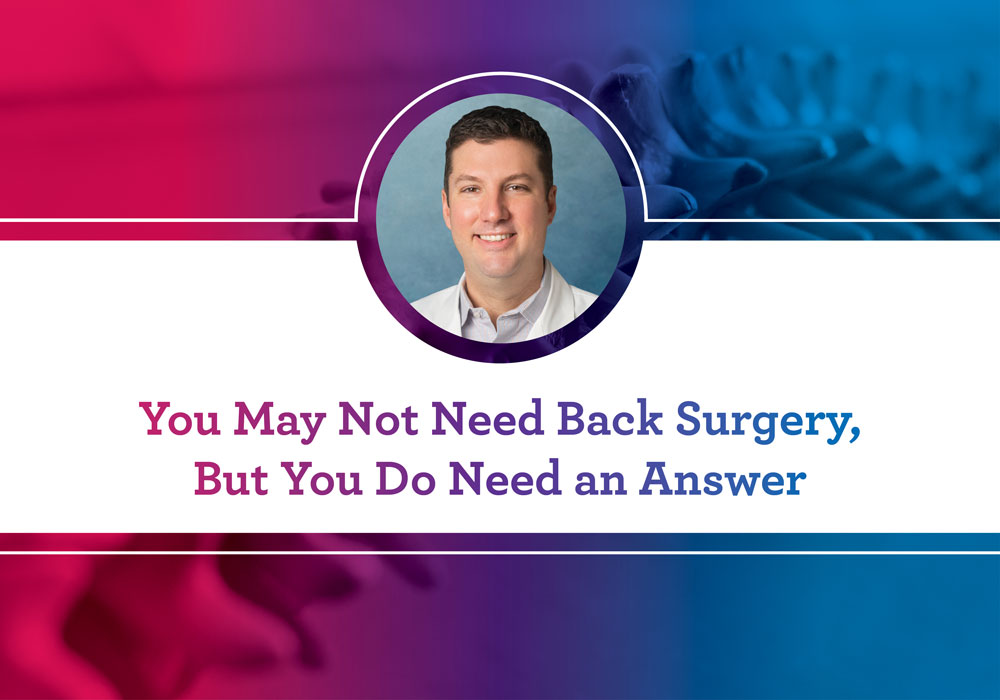
What OrthoIndy non-operative spine physician Dr. Mark Osborne wants patients to know
For six months, Nathan Sapp could barely sleep.
The real estate developer and tree farmer was injured in a UTV rollover in July 2024 while touring a property. He broke both feet and spent months recovering, but the real trouble came after his feet healed. The shift in how he walked placed new strain on his spine, and the back pain that followed turned out to be far worse than anything the accident had first caused.
“I was in a lot of pain at the time, and it only seemed to get worse as time went on,” said Nathan. The discomfort ran from his lower back into his right hip. Daily tasks became difficult. And for a six-month stretch, he rarely slept more than a couple of hours a night.
“The pain affected everything I did,” he said. “I could no longer travel, enjoy time with family and friends, or work on our 200-acre black walnut tree farm. By that point, I knew I needed help.”
His path led him to OrthoIndy and Dr. Mark Osborne, a fellowship-trained, board-certified physical medicine and rehabilitation (PM&R) specialist who focuses exclusively on non-surgical spine care. What happened next is the kind of story Dr. Osborne works toward every day — a patient who found lasting relief without ever going under the knife.
Surgery isn’t the only option — or even the first one
When most people think of seeing a spine specialist, they assume surgery is the destination. Dr. Osborne spends a lot of his time correcting that assumption.
“The majority of patients I see do not end up needing surgery,” says Dr. Osborne. “My job is to make sure we’ve found the right diagnosis and tried the right treatments before anyone considers an operation.”
At OrthoIndy, the non-surgical spine pathway begins with a thorough evaluation. This includes a review of medical history, a physical exam and imaging such as X-rays or MRI to identify exactly what’s causing a patient’s pain. From there, treatment options are matched to the individual. These may include physical therapy, non-opioid medications, epidural steroid injections, facet injections, nerve blocks or other targeted interventional procedures.
The goal is to restore function and reduce pain while helping patients avoid surgery and pain medications.
“We review the patient’s case, MRIs and then come up with an individualized treatment plan that’s right for that person,” Dr. Osborne says.
When conservative care isn’t enough, innovation fills the gap
After reviewing Nathan’s MRI, Dr. Osborne identified a herniated disc at the L5/S1 level. He began with conservative treatment — therapy and an epidural steroid injection — but the relief didn’t last. Rather than defaulting to surgery, Dr. Osborne offered Nathan a newer option: the VIA Disc NP procedure.
The minimally invasive treatment works by injecting healthy disc tissue directly into the damaged disc to help it rehydrate and restore its natural structure. Unlike treatments that only block pain signals, VIA Disc NP addresses tissue loss in the disc itself.
“With the information Dr. Osborne provided for me with VIA Disc NP, and compared to other options I had at the time, it seemed like the best option for me,” said Nathan.
He underwent the procedure in April 2025. The results were life-changing. His pain resolved, his disc rehydrated and he recovered without surgical intervention.
“Today, I feel great,” said Nathan. “I can’t tell a difference from before my back pain started and now. It has been amazing.”
He’s back to traveling, sitting comfortably on long flights, spending time on the beach and working his tree farm. The pain that once shaped every part of his life is now, in his words, a distant memory.
When to see a specialist — and why sooner matters
Not all back pain resolves on its own, and waiting too long can limit a patient’s options. Dr. Osborne encourages anyone experiencing the following symptoms to seek evaluation rather than hoping things improve:
- Pain that radiates into one or both legs
- Numbness, tingling or weakness in the legs or feet
- Pain that wakes you up at night or is worse lying down
- Back pain following an injury or accident
- Pain that has persisted more than four to six weeks without improvement
- Loss of bladder or bowel control (seek emergency care immediately)
These symptoms suggest nerve involvement or a structural problem that warrants a proper diagnosis — not more waiting.
For Dr. Osborne, early evaluation is about keeping options open. Patients who come in before their condition worsens are far more likely to find relief through conservative, non-surgical care. And when surgery eventually becomes appropriate, OrthoIndy’s non-operative and surgical spine teams work side by side to make that transition seamless.
“When I see a patient who isn’t getting better with conservative measures — whether physical therapy isn’t working or the injection isn’t helping as much as we want — that’s when I go across the hall to talk to one of my surgical partners,” Dr. Osborne says. “We review the case together and come up with the right plan.”
The right time to call is now
If back pain is affecting your work, your sleep or the things you love doing, this is a signal guiding you to act now. Not next month. Not after the holidays. Now.
Dr. Mark Osborne and his team are accepting new patients at OrthoIndy’s Carmel, Northwest and Westfield locations. An evaluation starts with understanding your history, reviewing imaging if needed, and building a plan designed around you.
To make an appointment with Dr. Osborne or one of his colleagues, call 317.802.2000 or request an appointment at orthoindy.com.