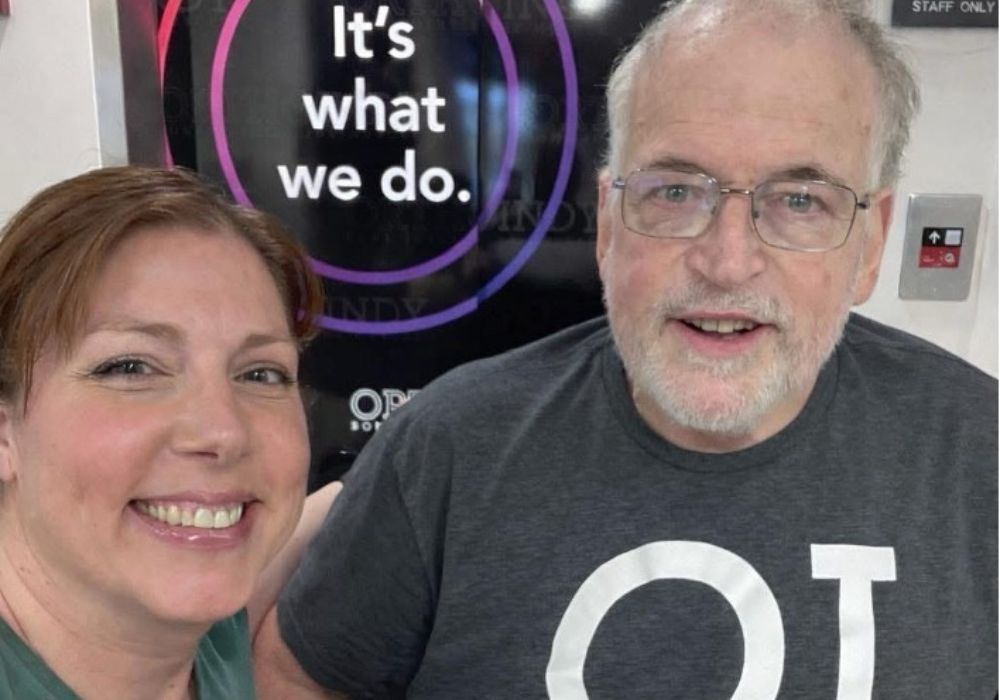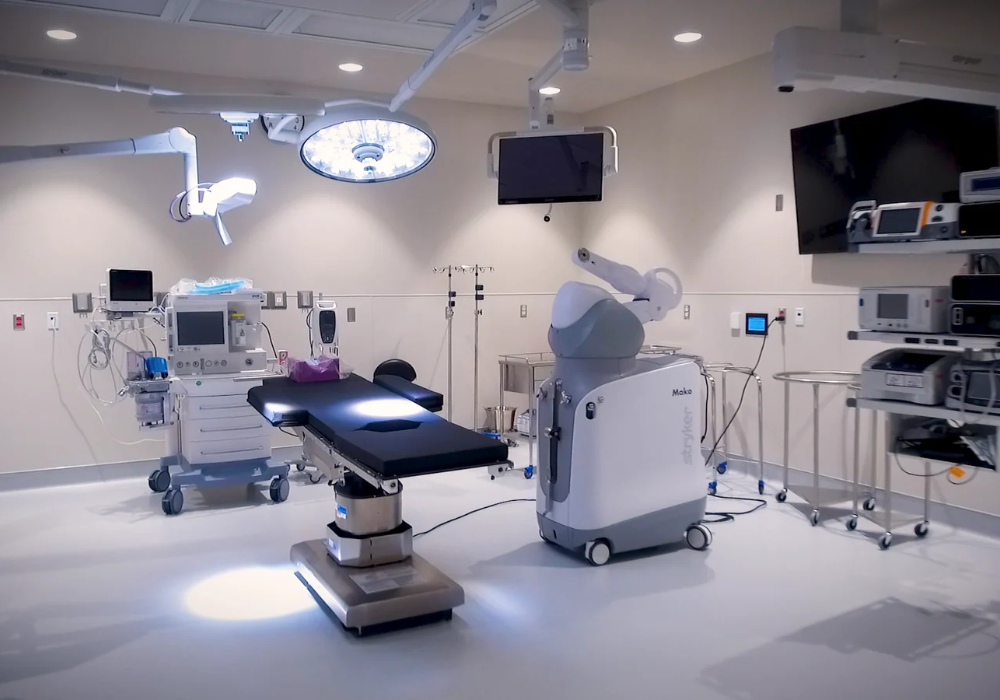
OrthoIndy surgeon Dr. Joel Virkler explains how Mako robotic-assisted technology helps personalize partial and total knee replacements.
OrthoIndy orthopedic surgeon Dr. Joel Virkler was skeptical of robotic-assisted knee replacement at first. Today, he uses Stryker’s Mako SmartRobotics for every knee replacement he performs.
Virkler, who completed a fellowship in joint reconstruction and sports medicine in Durham, North Carolina, uses Mako for both partial and total knee replacements for patients who undergo their surgery at Franciscan OrthoIndy Surgery Center in West Lafayette. Virkler combines advanced 3D imaging, personalized surgical planning and robotic-arm precision to help achieve optimal implant positioning and joint alignment.
“With Mako, we’re able to gather detailed information about both the bone and ligaments to create a surgical plan specific to each patient,” Virkler said. “This allows us to achieve a consistently balanced knee replacement designed to function as closely as possible to the patient’s natural knee.”
What makes Mako robotic-assisted knee replacement different?
Traditional knee replacement relies on the surgeon’s expertise and manual instruments to prepare the bone and position the implant.
While traditional techniques have a proven track record, Mako provides additional insights and precision to help surgeons plan and perform knee replacement surgery.
Before surgery, a CT scan creates a 3D model of the patient’s knee. Virkler uses the model to study the patient’s unique anatomy and plan the procedure.
During surgery, the system measures ligament tension, showing the surgeon how the knee will move and function with the implant in place.
“Traditional techniques tend to emphasize either bone alignment or ligament balancing,” Virkler said. “Mako allows us to evaluate both and make precise adjustments to achieve the best possible balance.”
The technology can be especially helpful for patients with significant bowlegged or knock-kneed deformities, where the relationship between bone alignment and ligament tension is critical.
How does the robotic arm assist the surgeon?
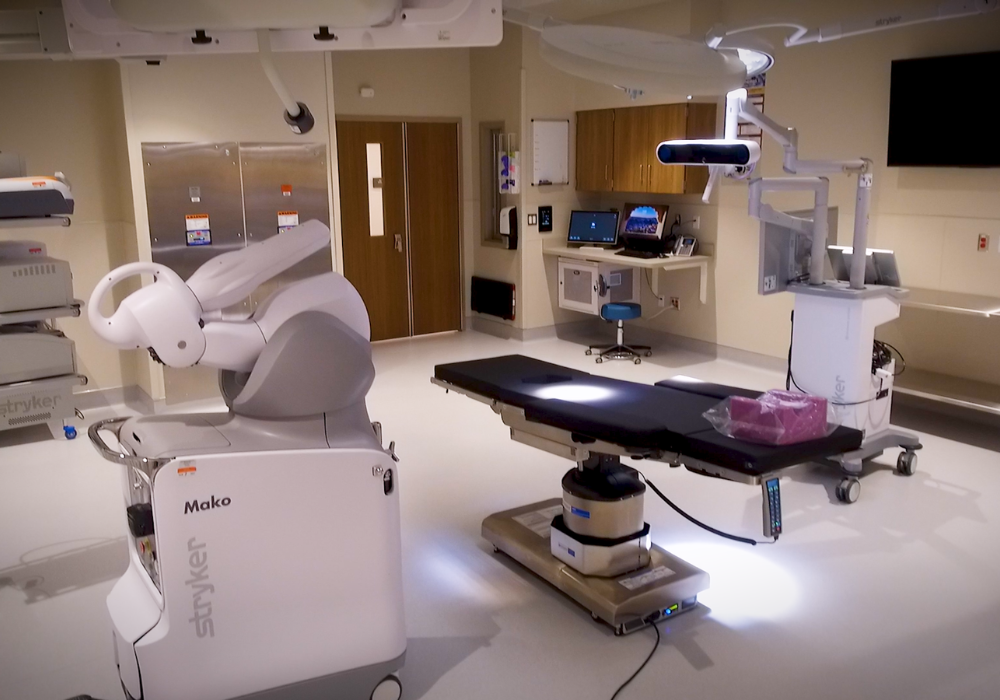
One common misconception about robotic-assisted knee replacement is that the robot performs the surgery on its own. In reality, the surgeon stays in control.
Virkler creates the surgical plan, makes clinical decisions and performs the operation. The Mako robotic arm is a tool that helps him carry out that plan.
The arm works within boundaries set in the surgical plan, which helps the surgeon prepare the bone accurately while protecting surrounding healthy tissue.
“Mako allows us to execute our surgical plan with accuracy within one degree and half a millimeter,” Virkler said. “It reduces the potential for errors in bone preparation and helps protect surrounding tissues from unintended contact with surgical instruments.”
Mako does not by itself make knee replacement minimally invasive. However, Virkler often pairs robotic assistance with a muscle-sparing surgical approach, which may reduce disruption to surrounding tissue.
What are the benefits of Mako knee replacement for patients?
The goal of any knee replacement is to relieve pain, restore function and improve quality of life. According to Virkler, Mako helps surgeons achieve more consistent implant positioning and a better-balanced knee.
He has seen the difference firsthand.
“I was initially a constructive critic and gradual adopter of this technology,” Virkler said. “But as I continued to see improvements in range of motion, mobility, pain levels and overall patient satisfaction, I increased my use of Mako. Today, I use it for 100% of my knee replacements.”
Virkler has also treated patients who had a traditional knee replacement on one knee and a Mako-assisted procedure on the other. In his experience, those patients generally had a better experience with the robotic-assisted procedure.
Based on what he has seen in his patients, benefits include:
- More precise implant positioning and joint alignment
- Better knee stability and range of motion
- Less disruption to surrounding healthy tissue
- Improved mobility and function after surgery
- Increased patient satisfaction
As with anything, individual results vary. Recovery depends on several factors, including overall health, the extent of arthritis and participation in rehabilitation.
Can Mako be used for partial and total knee replacements?
Yes. Mako can assist with both partial and total knee replacement.
A partial knee replacement may be appropriate when arthritis is limited to one area of the knee and surrounding ligaments remain healthy. A total knee replacement is generally recommended when arthritis affects more of the joint.
Virkler considers robotic assistance especially valuable in partial knee replacement, where precise implant positioning is essential to preserving the healthy parts of the knee.
Am I a candidate for Mako knee replacement?
Most patients who are candidates for knee replacement surgery can have a Mako-assisted procedure, as long as they can undergo the CT imaging used for surgical planning.
To decide which procedure is right, Virkler evaluates each patient’s symptoms, arthritis pattern, ligament stability and overall knee condition.
Advanced knee replacement care close to home
For patients in Northwest Indiana, advanced orthopedic technology means they don’t have to travel to Indianapolis for specialized knee replacement care.
“Historically, some patients in our community felt they needed to go to Indianapolis for more specialized joint replacement surgery,” Virkler said. “With fellowship-trained joint replacement surgeons and Mako robotics, OrthoIndy patients can receive expert orthopedic care right here in their community.”
What’s next for robotic knee replacement?
Virkler is excited about combining robotic surgical data with patient outcomes to keep refining implant positioning and surgical technique.
“Having the ability to collect data and learn from patient outcomes will help us continue improving how we perform joint replacement surgery,” he said.
For now, the greatest advantage is bringing together an experienced surgeon, individualized planning and advanced technology to help patients move with confidence.
Find relief from knee pain at OrthoIndy
Schedule an appointment if knee pain is limiting your mobility or keeping you from activities you enjoy, OrthoIndy’s joint replacement specialists can help you explore your options, from partial to total knee replacement.